#8 - Rhapsody in A Minor (The origin story)
Many composers were known for their unique approaches to the creative process. Late in his life, while fighting crippling hearing loss, Beethoven infamously sawed off the legs of his piano to hear the vibrations of his piano through the floor. Tchaikovsky was known to walk around his house, secluded in a Russian forest, and sing at the top of his lungs. Dvorak sought out indigenous folk melodies wherever he traveled for inspiration.
Now, please don’t assume that I’m comparing myself to any of these masters, but I do feel the origins of my most recent composition deserve to be mentioned in the annals of history. In about a month, the Central Illinois Youth Symphony, the orchestra that I was a part of from 2004-2008 and have been conducting since 2024, will premiere my new concert piece Rhapsody in A Minor.
And how did I write it, you might ask?
I was sitting on a lawnmower.
It was a spring day in 2006, the end of my junior year of high school, and I was mowing the yard on the family property. I grew up on a country acre just outside of town in Morton, Illinois, a town that proudly asserted itself as the “Pumpkin Capitol of the World” (this will definitely be the subject of a future blog post)
On this fateful day, I was ruminating on Tchaikovsky’s 5th symphony, a piece that I had recently performed with the CIYS. I loved the section at the beginning of the first movement when the bassoon played a haunting melody over a metronomic string section accompaniment (LINK HERE). As I played this part over and over in my head, something began to happen that was a creative staple of my childhood. I began to improvise on someone else’s original IP. Just like Digimon arriving a year after Pokemon in 1997, my best creative pursuits were often eerily similar and not as good as their derived source material. Take The Brandon Brothers for instance; my very poor attempt at a mystery novel was a brutal knockoff of The Hardy Boys by Franklin W. Dixon. Bill Watterson’s Calvin and Hobbes comic strip got an unfortunate reboot under my pen as Jeffrey and Pitch, a boy who goes on make-believe adventures with his stuffed dog. Thus, Tchaikovsky’s melody slowly morphed in my mind and became the subject for a brand new piece.
Thus, Rhapsody in A Minor was born.
I’ve always been quick to title my new works, often at the chagrin of the finished product down the road. In another infamous attempt to craft a mystery story, I wrote the Table of Contents (including chapter titles and page numbers) before sketching any parts of the story. It really made for some underbaked plot points and two of the characters listed in the “Character List” ended up not even making it into the story. Oh, well; at least I have some good fodder for a sequel.
As I sat on the lawnmower, this new melody now unfolding in my brain, I knew even then that it would be the beginning of a large orchestral work. Maybe a movement of a symphony? Maybe a tone poem? Maybe a rhapsody? Sure, I went with that one. Now I just had to finish writing a rhapsody.
At the time, I was aware of two rhapsodies in existence. The first, and probably most famous, was Queen’s “Bohemian Rhapsody.” The second was the Hungarian Rhapsody composed by Austrian piano extraordinaire Franz Liszt. From these two examples, I derived that a rhapsody was simply a sectional work where each new section could more or less stand on its own. Thus, this opening motif on the bassoon would be the primary character of the first section.
Once the lawn had been mowed to completion, I returned to my mini office that my parents had fashioned for me. It contained a Roland FP-5 digital keyboard and a USB connection to a desktop computer that contained the DAW called PowerTracks Pro Audio. I used this program for MIDI transcription directly from the piano. My notation program of choice was Sibelius 5. This is the program I fired up and began to notate these opening bars:

I added the strings next to give it the march-like feel that I was borrowing from Tchaikovsky.
And then, I was off.
Rarely do I hear large sections of music in my head at once, but on this afternoon, the entire opening section seemed to download to my brain like Windows 95 trying to process an Age of Empires CD-ROM. I used this main melody as the beginning of a canon which worked its way through all of the brass and the woodwinds. The section ends on a long held note in the violins before moving into the second section of the rhapsody.
Since I used Tchaikovsky’s 5th Symphony as the jumping off point for the first section, I decided to stick to my strengths and steal from another piece I was into at the time. The piece was The Sorcerer's Apprentice by French composer Paul Dukas, or, as is more commonly believed in pop culture, Mickey Mouse. While Mickey made the piece famous in the Disney classic Fantasia in 1940, the original work was premiered in 1897. Just like the piece begins with a dark, foreboding, atmospheric presence and then builds to a large orchestral anthem in triplets, I let my imagination wander down the same path until I built to this first grand anthem:
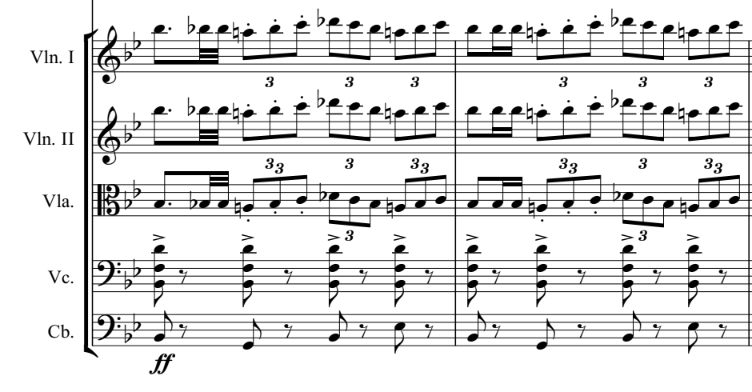
The two quick 32nd notes in the melody serve as a homage to the first section, while the dancing triplets are supposed to remind you of Dukas’s famous theme.
After the orchestra calms down, there is a brief moment of silence before the next section begins. This is the only section that I believe is not based on any original source material. It’s a melody that I’m actually quite proud of, and I liked it so much that it gets a treatment with just the strings, just the brass, and then a grand restatement in the finale section. This is also the last section I wrote before beginning the process of taking several years off between composing new sections.

I don’t have a timestamp on any of these sections, but I believe at least a couple years passed before I wrote the next section, which is a fugue. I’d like to think this corresponded with taking Tonal Counterpoint during my junior year at Illinois Wesleyan, but I don’t have the energy to do the digital research at this point.
To write the fugue, I used the opening bassoon melody as the idea for the subject (though now in A Major) and gave it to a solo flute. The next voice to enter is the oboe followed by the bassoon. Rather than make it a pure four-voice fugue, I bring in all of the strings and woodwinds to riff on the subject and countersubject. By throwing in the snare drum, it almost feels like a mini dance break was required to bring us out of the Baroque era and back in the Romantic period.
The next section takes the major derivation of the opening motif and pays homage to one of my favorite pieces I played during my time at Illinois Weselyan, Mussorgsky’s Pictures at an Exhibition, particularly the movement titled “The Great Gate of Kiev.”
Every musician will experience a handful of moments in their life where the sheer wonder and majesty of a piece of music transports them to a cerebral state of pure bliss. Pictures did this for me. At the first rehearsal, under the baton of Steve Eggleston, when the low brass began the “Great Gate” movement, I immediately knew that this piece was going to be in my life forever. Thus, it seemed fitting to steal Mussorgsky’s idea (and Maurice Ravel’s orchestration techniques) to be used in this rhapsody.
The next section breaks the formal rules of the rhapsody and revisits material from the beginning of the piece. However, in the larger scheme of themes, this section functions as a transition, so I don’t feel that bad about it. I decided to bring back the opening theme in the bassoon, albeit a truncated version.
This transitions into one of my favorite sections, and I know I wrote this during my senior year at Wesleyan because it was inspired by the trombone concerto we played with CSO bass trombonist Charlie Vernon that spring. The piece, Chick-A-Bone Checkout, was composed by Charles Lindbergh, and it was a tour-de-force of sound! The opening movement was hectic and metrically chaotic in the best of ways, and I evoked that feeling for the next section of the rhapsody. There are some arpeggios in the woodwinds that I doubt are playable but were lots of fun to write.
This is the last section I remember writing for a good long while. After Wesleyan, I got my first job as Orchestra Director at Morton High School, and while I did a lot of writing for string orchestra during this time, I would only occasionally sit down and ponder what to do with this rhapsody. By looking at my sketchbooks, I know that I sketched out what would become the finale sometime during this decade, but I don’t remember actually sitting down at Sibelius and notating these sections until the Covid pandemic of 2020.
Using the sketch for the finale as my endpoint, I’m guessing that I worked my way backward to see what I could do to get there from what I had already written. If I had to guess, I think I saw the piece starting to come together as a whole product in my brain, and I knew that I was near the finish line.
I knew that I wanted to end the piece like the grand finale of Franz Liszt’s epic tone poem Les Preludes. I performed this piece while at Wesleyan, and it has always stuck with me again as one of “those moments.” Anytime a brass section is playing a slow, majestic anthem underneath a flurry of activity in the winds and strings, I think that’s a formula for a thrilling finale. The get to the finale, I decided to once again bring back the opening theme in the bassoon, though once again not as a direct restatement. This leads into a transition section to set up the finale. It’s a slow build of several chords, each one more dissonant than the last. However, when they finally resolve to E major, the sprint to the finish has begun, and the brass bring back the original chorale that they played in the first half of the piece.
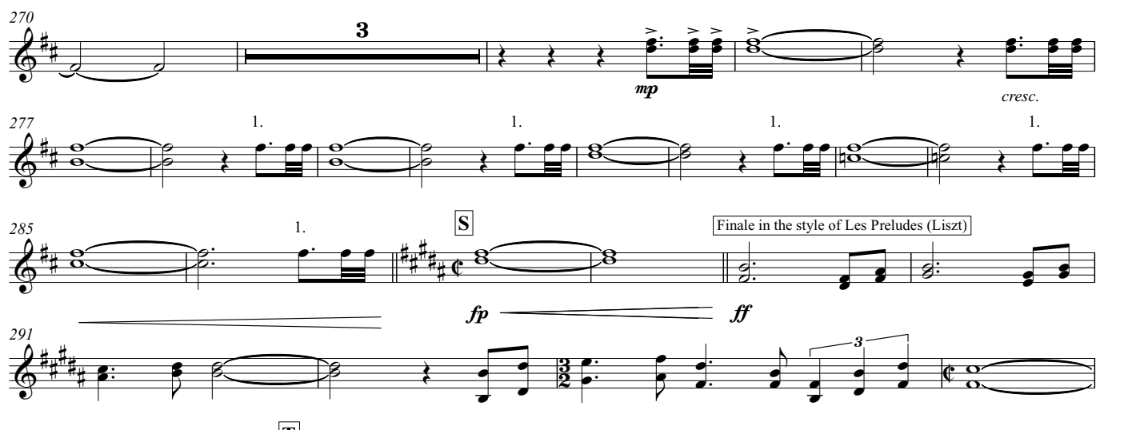
This is an excerpt from the French Horn part.
And that brings us to the coda. I decided to end the piece with one more major restatement of the opening melody, the melody that started the whole fifteen year process of writing the piece. It’s played once in the strings and once in the winds before the final chords signal the piece’s completion.
That’s the story of how the piece came together. The story of the premiere is a bit shorter to tell. When I assumed the role of conductor of the Central Illinois Youth Symphony in 2024, I was told that the next season would mark the organization’s 60th anniversary. It seemed fitting to commission a new work for the occasion, and I decided to share how Rhapsody in A Minor only came about because of my involvement in the Youth Symphony. The executive director, Lidia Riley, immediately green lit the idea, and the premiere date was set for May 3, 2026. Rehearsals began that winter, and the students immediately took to the piece and prepared it very well. The fugue section was the hardest to get together, and it even required some rewriting right up until the week of the performance.
And here I sit now, typing this last paragraph three days before the premiere itself. I can’t wait to hear the work actually come together in a concert setting, and I hope the audience is able to connect with the various sections and hear something that they enjoy.
And to think it all started on a lawn mower.